Quick Summary
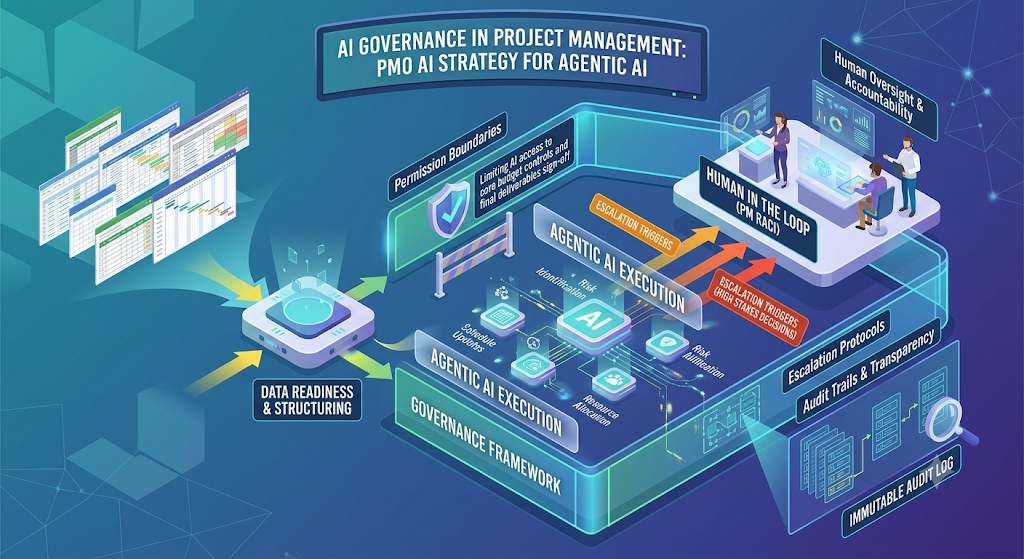
● Define clear decision boundaries. Organizations must establish explicit rules dictating what AI agents in project management can execute independently and what requires human authorization. This prevents unintended actions from impacting critical project baselines.
● Maintain human accountability. While autonomous AI in project management can recommend actions and draft reports, accountability for project outcomes remains firmly with human project managers. Governance frameworks must reflect this non-delegable responsibility.
● Implement robust audit trails. Every action taken by AI agents for PMO must be logged in an immutable record to ensure traceability. This transparency is essential for compliance, troubleshooting, and understanding the rationale behind AI-generated recommendations.
● Establish escalation protocols. PMO AI strategy must include predefined triggers that automatically route high-stakes decisions or ambiguous scenarios to human overseers. This ensures that complex risks are managed with human judgment and context.
● Prioritize data readiness. Agentic AI for PMO relies entirely on the quality of underlying portfolio data. PMOs must structure and connect their data environments before deploying agents to ensure accurate, reliable, and unbiased outputs.
Introduction
The integration of AI agents in project management represents a fundamental shift from passive assistance to active execution. As these tools evolve to update schedules, surface risks, and trigger workflows, PMOs must adapt their oversight models. The focus is no longer just on what the technology can do, but how it should be governed to protect organizational assets.
Agentic AI for PMO introduces powerful capabilities, but these advancements require strict permission boundaries to ensure alignment with strategic goals. Without proper AI project management governance, organizations risk losing traceability and accountability when autonomous systems interact with live project data. Establishing a mature PMO AI strategy ensures that technology enhances project delivery while mitigating operational risks.
This article explores the critical governance frameworks required for autonomous AI in project management. We will examine how to define decision boundaries, maintain human oversight, and build robust audit trails. By addressing these governance questions proactively, PMO leaders can safely harness the power of AI agents to drive portfolio success.
|
Primary
|
Secondary
|
|
AI governance in project management
|
AI agents in project management / PMO AI strategy / Agentic AI for PMO
|
|
AI project management governance
|
autonomous AI in project management / AI agents for PMO / PMO AI strategy
|
|
Agentic AI for PMO
|
AI agents in project management / AI governance in project management / autonomous AI in project management
|
|
PMO AI strategy
|
AI agents for PMO / AI project management governance / Agentic AI for PMO
|
|
AI agents in project management
|
autonomous AI in project management / AI governance in project management / PMO AI strategy
|
Key Factors Overview
|
Factor
|
Description
|
|
Decision Boundaries
|
Establishing explicit rules that separate autonomous AI actions from those requiring human approval.
|
|
Auditability
|
Creating immutable logs of all AI-driven recommendations, data inputs, and executed workflows for traceability.
|
|
Human Oversight
|
Ensuring that certified project managers retain ultimate accountability for project outcomes and strategic decisions.
|
|
Data Readiness
|
Structuring and centralizing portfolio data to provide AI agents with accurate, unbiased information.
|
|
Escalation Protocols
|
Defining the specific risk thresholds or ambiguous scenarios that force an AI agent to defer to a human leader.
|
Before Checklist
● Document decision boundaries. Before deploying AI agents, write a formal specification detailing which actions are autonomous, which are supervised, and which are strictly prohibited. This foundational step prevents scope creep and unauthorized system behavior.
● Assess data infrastructure. Evaluate your current portfolio data for accuracy, consistency, and completeness across all integrated platforms. AI agents require a single source of truth to generate reliable forecasts and avoid compounding existing data errors.
● Define human accountability roles. Update your RACI matrices to explicitly state that human project managers remain accountable for deliverables, even when AI assists in their creation. This clarifies expectations and maintains professional standards.
● Establish rollback mechanisms. Design system architectures that allow PMOs to instantly reverse actions taken by autonomous agents. This safety net is critical for mitigating the impact of erroneous AI updates to schedules or resource allocations.
After Checklist
● Monitor audit logs regularly. Conduct routine reviews of the immutable logs generated by AI agents to verify compliance with established decision boundaries. This ongoing scrutiny helps identify anomalies before they escalate into systemic issues.
● Evaluate escalation frequency. Analyze how often AI agents trigger escalation protocols to defer decisions to human managers. High escalation rates may indicate a need to refine the agent's training data or adjust its operational parameters.
● Review data quality continuously. Implement automated checks to ensure the data feeding your AI agents remains structured and accurate over time. Degradation in data quality will directly impact the reliability of AI-generated risk assessments.
● Update governance policies. Revisit your PMO AI strategy quarterly to adapt to new AI capabilities and emerging organizational needs. Governance must evolve alongside the technology to remain effective and relevant.
Table of Contents
SECTION 1: Establishing Governance Foundations
1. Why do AI agents create a new governance challenge for PMOs?
2. What are the essential permission boundaries for Agentic AI?
3. How should PMOs balance human approval versus autonomous action?
SECTION 2: Managing Risk and Accountability
4. Who is accountable when an AI-generated action affects a project?
5. When should escalation rules trigger human intervention?
6. Can audit trails ensure traceability for AI decisions?
SECTION: STRUCTURING THE INTAKE WORKFLOW
FAQ 1: Why do AI agents create a new governance challenge for PMOs?
AI agents introduce new governance challenges because they transition technology from a passive reporting tool to an active participant capable of executing workflows. This shift requires PMOs to manage the risks associated with autonomous actions that could impact project baselines.
Unlike traditional software that only follows rigid scripts, agentic systems can pursue goals and make probabilistic decisions based on context. As noted in [Enterprise AI Agent Projects: The Governance Crisis PMs Need to Solve](https://www.institutepm.com/knowledge-hub/enterprise-ai-agent-governance-crisis-2026), governance for agents means defining decision boundaries and explicit human checkpoints for high-stakes actions. Without these controls, organizations face significant compliance and operational risks.
Real Results: Organizations that implement strict governance frameworks for AI agents experience fewer unauthorized workflow changes and maintain higher compliance standards.
Takeaway: PMOs must evolve their governance models to oversee active AI execution, not just passive data analysis.
FAQ 2: What are the essential permission boundaries for Agentic AI?
Essential permission boundaries categorize AI actions into three distinct tiers: autonomous execution, supervised action requiring human approval, and strictly prohibited activities. Defining these tiers is the cornerstone of effective AI project management governance.
For example, an AI agent might be authorized to autonomously draft a weekly status report based on task updates. However, reallocating budget reserves or changing a critical path dependency must fall under the supervised tier, requiring a project manager's sign-off. Establishing these boundaries prevents agents from taking irreversible actions that could jeopardize project delivery.
Real Results: PMOs that document clear decision boundaries reduce the risk of AI-driven errors impacting critical project financials by ensuring high-stakes actions are always human-approved.
Takeaway: Clearly defined permission tiers protect project integrity while allowing AI to automate routine administrative tasks.
FAQ 3: How should PMOs balance human approval versus autonomous action?
PMOs should balance human approval and autonomous action by aligning the level of oversight with the potential impact and reversibility of the AI's decision. Low-risk, easily reversible actions can be automated, while high-impact decisions require human judgment.
To achieve this balance, PMOs must implement a "human-in-the-loop" approach for complex problem-solving and strategic alignment. According to [AI Project Portfolio Management: The AI-Powered PMO Guide](https://corasystems.com/blog/ai-project-portfolio-management-guide), AI agents cannot be accountable entities, meaning oversight must stay with people. The technology handles data processing and recommendations, while humans provide empathy, negotiation, and final authorization.
Real Results: Portfolios utilizing a human-in-the-loop model benefit from the speed of AI data processing without sacrificing the strategic nuance provided by experienced project managers.
Takeaway: Reserve autonomous action for reversible, low-impact tasks, and mandate human approval for strategic project decisions.
SECTION: Managing Risk and Accountability
FAQ 4: Who is accountable when an AI-generated action affects a project?
Accountability for any AI-generated action that affects a project rests entirely with the human project manager and the governing PMO. Technology cannot hold accountability; it is a tool utilized by professionals to support delivery.
When an AI agent recommends a schedule change or identifies a resource conflict, the project manager is responsible for validating that information before acting on it. Governance frameworks must explicitly state this relationship in RACI matrices and project charters. As highlighted in [Challenges of Implementing AI in Project Management | APMG International](https://apmg-international.com/article/challenges-implementing-ai-project-management), organizations must include AI-assisted activities alongside the accountable human role to reinforce that ownership has not been delegated.
Real Results: PMOs that clearly define human accountability for AI outputs maintain higher standards of project quality and stakeholder trust.
Takeaway: Human professionals are always accountable for project outcomes, regardless of the AI tools used to achieve them.
FAQ 5: When should escalation rules trigger human intervention?
Escalation rules should trigger human intervention whenever an AI agent encounters ambiguous data, conflicting priorities, or scenarios that exceed its predefined confidence thresholds. These rules act as a safety valve for complex situations requiring contextual understanding.
For instance, if an AI agent detects a resource conflict between two high-priority strategic initiatives, it should not attempt to resolve it autonomously. Instead, the system must escalate the issue to a portfolio manager who can weigh the strategic trade-offs. Proper escalation protocols ensure that AI limitations do not result in poor portfolio decisions.
Real Results: Implementing automated escalation triggers for ambiguous scenarios prevents AI agents from making incorrect assumptions, thereby protecting portfolio alignment.
Takeaway: Escalation rules ensure that complex, high-stakes conflicts are resolved by human leaders with strategic context.
FAQ 6: Can audit trails ensure traceability for AI decisions?
Yes, immutable audit trails are essential for ensuring traceability, allowing PMOs to track exactly what data an AI agent used and which human approved its recommendations. This transparency is vital for compliance and continuous improvement.
An effective audit trail logs the agent's inputs, the probabilistic reasoning behind its output, and the final action taken. If a project experiences an issue due to an AI recommendation, the PMO can use the audit log to investigate the root cause. This level of explainability is a core requirement for mature AI governance in project management.
Real Results: Organizations utilizing immutable logging for AI actions can quickly audit project decisions, satisfying regulatory compliance and internal governance audits.
Takeaway: Comprehensive audit trails provide the transparency necessary to trust and verify AI agent activities within the PMO.