Quick Summary
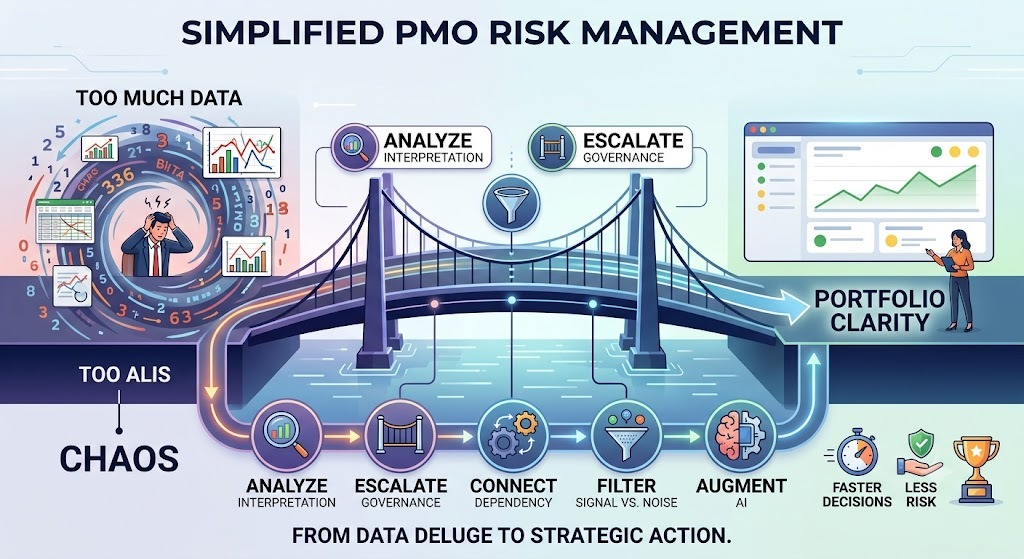
● Data volume is not clarity. Having massive amounts of project management data often obscures the true threats facing a portfolio. PMO leaders must filter the noise to find actionable signals that impact strategic goals.
● Lagging versus leading indicators. Traditional project risk reporting relies heavily on lagging indicators that show what has already happened. Effective PMO risk management requires identifying early warning signs before they escalate into critical issues.
● The escalation disconnect. Risks often remain trapped at the project level due to unclear reporting lines or a reluctance to escalate. Without defined thresholds, strategic threats go unnoticed until they materialize and impact the broader organization.
● Cross-project dependencies. Small issues become significant when viewed across multiple projects within a portfolio. Portfolio risk visibility depends on understanding these complex interdependencies and resource constraints.
● AI as an analytical assistant. Artificial intelligence can help identify patterns and anomalies in project portfolio intelligence. However, it is meant to augment human judgment and governance, not replace the PMO decision-making process.
Introduction
The modern Project Management Office is drowning in project management data, yet many leaders still struggle to achieve true PMO risk visibility. Dashboards, status updates, and risk registers are abundant, but they often fail to highlight which issues are becoming materially important across the portfolio. This creates a dangerous illusion of control where information is collected but not effectively interpreted.
The core problem is rarely a lack of information or a need for new technology. Instead, the challenge lies in separating meaningful signals from routine project updates. When every minor issue is logged with equal weight, project portfolio risk management becomes an exercise in administrative compliance rather than strategic foresight.
To achieve genuine portfolio risk visibility, organizations must bridge the gap between data collection and executive decision-making. This requires consistent governance, clear escalation thresholds, and a shift from merely reporting risks to actively detecting emerging threats. By refining how data is interpreted, PMO directors can transform raw inputs into actionable project portfolio intelligence.
|
Primary
|
Secondary
|
|
PMO risk visibility
|
portfolio risk visibility / project risk reporting / PMO risk management
|
|
project portfolio intelligence
|
project management data / portfolio risk management / strategic insights
|
|
project management data
|
data quality / project metrics / portfolio analytics
|
|
portfolio risk visibility
|
executive reporting / risk dashboards / portfolio health
|
|
project risk reporting
|
risk registers / status updates / escalation thresholds
|
|
PMO risk management
|
risk governance / risk interpretation / PMO strategy
|
|
project portfolio risk management
|
enterprise risk / cross-project dependencies / risk mitigation
|
Key Factors Overview
|
Factor
|
Description
|
|
Data Interpretation
|
The ability to translate raw project metrics into meaningful insights that highlight emerging threats to the portfolio.
|
|
Escalation Governance
|
Defined rules and thresholds that dictate when a project-level risk must be elevated to the portfolio or executive level.
|
|
Dependency Tracking
|
Monitoring how a delay or resource constraint in one project cascades and impacts other initiatives within the portfolio.
|
|
Signal vs. Noise
|
The process of filtering out routine, low-impact project updates to focus on risks that threaten strategic objectives.
|
|
Analytical Augmentation
|
Using advanced analytics and AI to spot trends and anomalies, supporting rather than replacing human PMO judgment.
|
Before Checklist
● Audit your current risk registers. Review existing project risk logs to determine if they are filled with routine operational issues rather than genuine threats. Identify how many risks have been open for months without actionable mitigation plans.
● Evaluate your escalation pathways. Check if project managers have clear, documented criteria for when to escalate a risk to the PMO. Determine if risks are currently trapped at the project level due to a lack of governance.
● Assess dashboard utility. Look at your current executive dashboards to see if they highlight emerging trends or just summarize past performance. Ask stakeholders if the data presented actually helps them make resource or strategic decisions.
● Review dependency tracking. Examine how your PMO currently tracks shared resources and cross-project dependencies. Identify instances where a minor delay in one project caused unexpected disruptions in another.
After Checklist
● Define clear escalation thresholds. Establish specific quantitative and qualitative triggers that require a risk to be moved from project-level tracking to portfolio-level visibility. Ensure all project managers understand and use these criteria.
● Implement leading indicators. Shift the focus of project risk reporting to include early warning signs, such as consecutive missed micro-milestones or subtle shifts in resource availability. Train teams to look forward rather than just reporting on the past.
● Establish portfolio-level risk reviews. Schedule regular governance meetings dedicated solely to analyzing aggregated risk data across the portfolio. Use these sessions to identify systemic issues and cross-project vulnerabilities.
● Integrate analytical tools thoughtfully. Deploy AI or advanced analytics to help identify patterns in your project management data, such as recurring vendor delays. Ensure these tools are used to inform PMO discussions, not to automate critical decisions.
Table of Contents
SECTION 1: The Data and Visibility Disconnect
1. Why does more project management data not always create more clarity?
2. What is the difference between reporting a risk and detecting an emerging risk?
3. How do small issues become more significant when viewed across multiple projects?
SECTION 2: Governance, Interpretation, and Technology
4. Why do consistent governance and escalation thresholds matter for PMO risk management?
5. How does dependency, schedule, and resource data impact risk interpretation?
6. Can AI-assisted analysis help identify patterns without replacing PMO judgment?
SECTION: The Data and Visibility Disconnect
FAQ 1: Why does more project management data not always create more clarity?
An abundance of data often creates noise, making it difficult for PMO leaders to identify the signals that truly matter. When organizations collect every possible metric without a clear strategy, the sheer volume of information can overwhelm decision-makers.
Many organizations mistakenly believe that capturing more data points will automatically yield better insights. However, as noted by industry experts, data analytics in project management only work when the data is clean, consistent, and accessible; otherwise, it simply creates a reporting burden [Project Management Analytics: Building the Data Foundation for Better PMO Reporting - Withum](https://www.withum.com/resources/project-management-analytics-building-the-data-foundation-for-better-pmo-reporting). Without a framework to interpret this information, PMOs spend their time formatting reports rather than analyzing portfolio health.
Real Results: A global financial services firm reduced its weekly PMO reporting metrics from 50 to 12, resulting in a faster identification of critical portfolio risks and more focused executive meetings.
Takeaway: Clarity comes from the strategic interpretation of targeted data, not from the indiscriminate collection of every project metric.
FAQ 2: What is the difference between reporting a risk and detecting an emerging risk?
Reporting a risk involves logging a known issue, whereas detecting an emerging risk requires identifying subtle trends before they become formal threats. Reporting is often a reactive administrative task, while detection is a proactive analytical process.
Traditional project risk reporting typically relies on lagging indicators, capturing problems that have already materialized or are widely acknowledged by the project team. In contrast, detecting emerging risks involves analyzing project portfolio intelligence to spot early warning signs, such as slight schedule variances or resource overallocations. This proactive approach allows the PMO to intervene before a minor variance escalates into a critical failure.
Real Results: By shifting focus from static risk registers to analyzing weekly schedule variance trends, a healthcare PMO identified a systemic vendor delay three weeks before it officially impacted project delivery.
Takeaway: Effective PMO risk management requires moving beyond administrative logging to actively hunting for early warning signals in the data.
FAQ 3: How do small issues become more significant when viewed across multiple projects?
Minor project-level variances can compound across a portfolio, creating severe bottlenecks due to shared resources and dependencies. What appears as a negligible delay in one project can trigger a cascade of failures in others.
When risks are only viewed in isolation, project managers may deem them acceptable or easily manageable. However, portfolio risk visibility reveals how these isolated issues interact; for example, a two-day delay in a foundational IT project might force three dependent projects to miss their launch windows. The PMO must aggregate these tactical risks to understand their true strategic impact on the organization.
Real Results: A manufacturing company discovered that a minor, recurring quality issue in one component was actually causing schedule delays across four different product development pipelines.
Takeaway: Portfolio risk visibility requires analyzing the interconnected nature of projects to prevent small, isolated issues from causing systemic disruptions.
SECTION: Managing Risk and Accountability
FAQ 4: Why do consistent governance and escalation thresholds matter for PMO risk management?
Without defined escalation thresholds, critical risks often remain trapped at the project level until it is too late for executive intervention. Consistent governance ensures that threats are elevated based on objective criteria rather than subjective judgment.
Risks often go unreported to the portfolio level due to unclear reporting lines, inadequate templates, or a reluctance by project managers to escalate bad news [PMO Risk Management And Strategy: The Ultimate Guide To Governance - PM Resource Hub - The Center Of Excellence For Project Professionals](https://pmresourcehub.com/pmo-risk/). Establishing an escalation matrix defines clear pathways for risk escalation, ensuring that executives are informed of strategic threats without being overwhelmed by tactical details. This structured approach builds trust and ensures timely decision-making.
Real Results: An enterprise IT PMO implemented a standardized escalation matrix, reducing the time it took for critical project risks to reach the steering committee from three weeks to three days.
Takeaway: Clear governance and escalation rules are the mechanisms that transform project-level data into actionable portfolio-level intelligence.
FAQ 5: How does dependency, schedule, and resource data impact risk interpretation?
These data points provide the necessary context to understand the true severity and potential impact of an identified risk. A risk cannot be accurately assessed without knowing how it affects timelines, budgets, and the people doing the work.
When PMOs integrate schedule and resource data with their risk registers, they move from a static list of threats to a dynamic view of portfolio health. For instance, understanding resource constraints helps the PMO realize that mitigating a risk in Project A might inadvertently starve Project B of critical personnel. This holistic view is essential for effective project portfolio risk management and strategic resource allocation.
Real Results: By linking their risk register directly to resource allocation data, a construction PMO successfully reallocated engineering teams to prevent a major compliance risk from delaying a flagship project.
Takeaway: Risk interpretation is only accurate when it is cross-referenced with the realities of project schedules, dependencies, and resource availability.
FAQ 6: Can AI-assisted analysis help identify patterns without replacing PMO judgment?
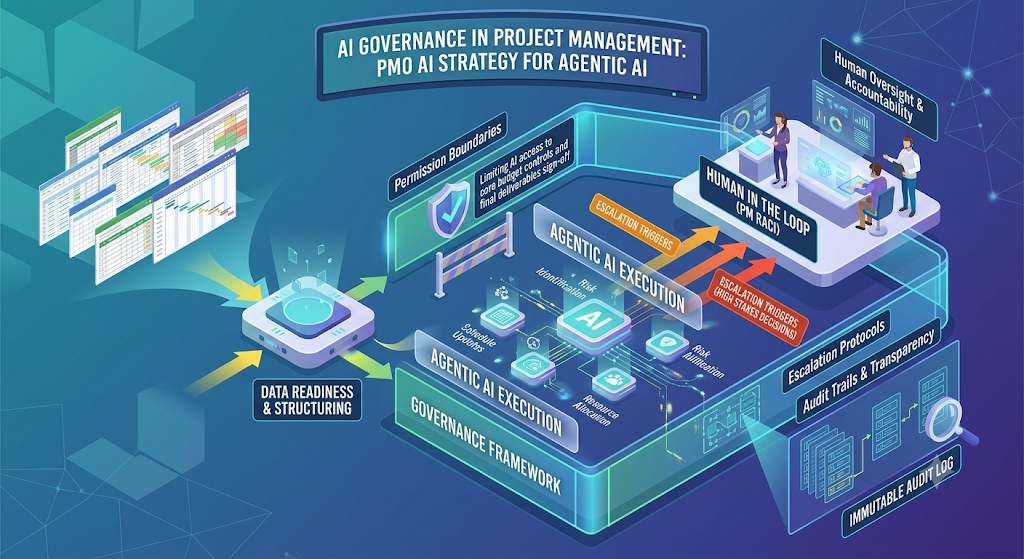
Yes, AI can rapidly process vast amounts of project management data to highlight anomalies and trends, acting as a powerful analytical assistant. It excels at pattern recognition, leaving the complex strategic decision-making to human leaders.
AI tools can analyze meeting notes, schedule variances, and resource data to detect subtle shifts, such as negative sentiment or recurring supplier delays, that might escape manual review [AI in Project Portfolio Management: PMO Guide 2026](https://www.simpliaxis.com/resources/ai-in-project-portfolio-management). Furthermore, AI-native intelligence allows PMOs to instantly access portfolio insights and identify risks from a trusted data foundation [From Project Risk Visibility to Portfolio Confidence: How Planisware Strengthens PMO Governance | Planisware](https://planisware.com/resources/risk-management/project-risk-visibility-portfolio-confidence-how-planisware-strengthens). However, the PMO must still interpret these AI-generated insights within the context of organizational strategy and culture.
Real Results: A technology firm used AI to analyze historical project data, identifying a recurring pattern of testing phase delays that allowed the PMO to adjust future project schedules proactively.
Takeaway: AI is a tool for enhancing project portfolio intelligence and spotting hidden patterns, but human governance remains essential for strategic risk response.