Quick Summary
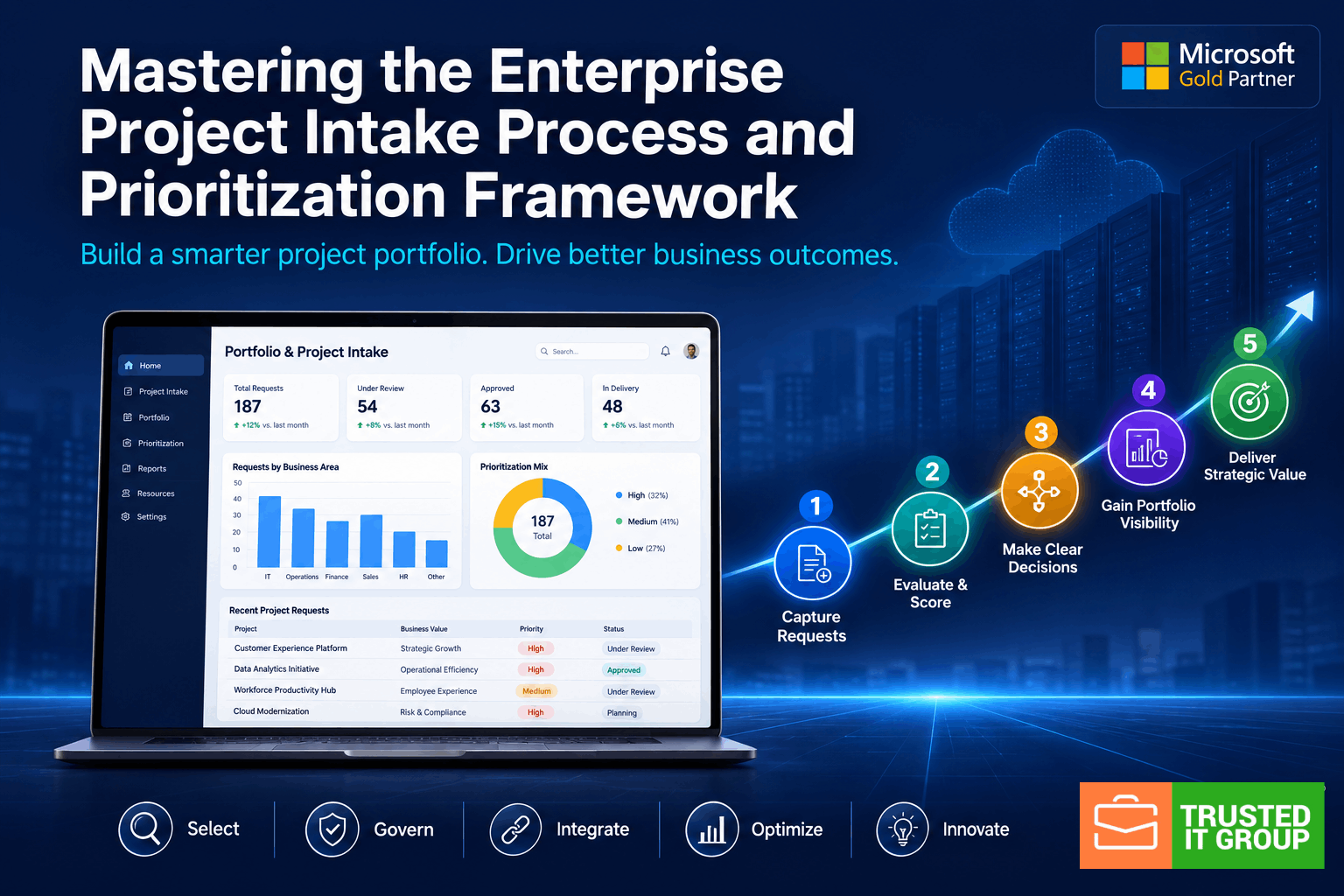
● Capture demand consistently: A structured project intake process ensures all new initiatives enter the organization through a unified channel. This prevents backdoor requests and provides a single source of truth for incoming work.
● Evaluate with objective criteria: Utilizing a robust project prioritization framework allows teams to score requests based on strategic value, risk, and resource needs. This removes emotion from decision-making and aligns work with business goals.
● Define clear decision points: Establishing specific gates ensures stakeholders know if an idea is being explored, approved, deferred, or declined. This clarity prevents teams from committing resources prematurely.
● Gain portfolio-level visibility: Integrating project portfolio intake with existing commitments highlights capacity constraints before new work begins. Leadership can then make informed trade-offs rather than overloading delivery teams.
● Partner for governance success: Trusted IT Group helps organizations refine their project request process, governance models, and data structures. Expert guidance ensures that intake workflows integrate seamlessly with enterprise project management systems.
Introduction
Many project-delivery problems originate long before execution actually begins. When initiatives enter an organization through fragmented channels, leadership lacks a complete picture of incoming demand. Without a standardized project intake process, teams often begin committing valuable resources to poorly defined ideas, leading to downstream bottlenecks and misaligned priorities.
Rather than treating prioritization as a once-a-year planning exercise, organizations need a repeatable intake and evaluation structure. A well-designed project request process captures essential information upfront, allowing PMO leaders to evaluate strategic value, urgency, dependencies, and risks. This structured approach ensures that only the most viable and strategically aligned initiatives move forward into the planning phase.
Establishing this discipline requires more than just implementing new software; it demands strong governance and organizational judgment. Trusted IT Group partners with enterprise PMOs to design and implement the processes, data structures, and project-management systems necessary for effective portfolio decision-making. By creating clear visibility into both new demand and existing commitments, organizations can confidently decide which work truly deserves their attention.
|
Primary
|
Secondary
|
|
project intake process
|
enterprise project intake / PMO intake workflow / project intake best practices
|
|
enterprise project prioritization
|
portfolio prioritization / strategic project alignment / enterprise demand management
|
|
project request process
|
project request form / initiative request workflow / IT project requests
|
|
PMO project intake
|
PMO demand management / PMO governance / PMO intake framework
|
|
project portfolio intake
|
portfolio demand management / portfolio pipeline / portfolio intake governance
|
|
project prioritization framework
|
scoring rubric / prioritization matrix / objective project scoring
|
Key Factors Overview
|
Factor
|
Description
|
|
Strategic Alignment
|
Evaluates how well a proposed initiative supports overarching business objectives and key results.
|
|
Resource Capacity
|
Assesses the availability of required personnel and funding against existing portfolio commitments.
|
|
Risk Assessment
|
Identifies potential technical, financial, or operational risks before a project is officially approved.
|
|
Decision Gates
|
Establishes formal checkpoints to determine if a request is approved for planning, deferred, or declined.
|
|
Business Value
|
Measures the expected financial return, compliance necessity, or operational improvement of the initiative.
|
Before Checklist
● Identify current intake channels: Map out all the different ways project requests currently enter the organization. Understanding whether requests come through emails, hallway conversations, or formal documents helps highlight gaps in the existing workflow.
● Review past project failures: Analyze recent projects that struggled due to poor initial scoping or resource shortages. This analysis often reveals critical information that should have been captured during the initial request phase.
● Assess resource visibility: Determine if leadership has a clear view of team capacity before approving new work. If resource allocation is a guessing game, the intake process must incorporate capacity forecasting.
● Evaluate existing criteria: Look at how decisions are currently made regarding which initiatives get funded. If decisions rely solely on executive influence rather than objective data, a new scoring model is necessary.
After Checklist
● Implement a unified request form: Ensure all new initiatives are submitted through a single, standardized project request process. This guarantees that every proposal contains the same baseline information for fair evaluation.
● Establish a scoring rubric: Apply a consistent project prioritization framework to evaluate strategic value, risk, and financial impact. Objective scoring helps governance committees filter out low-value requests efficiently.
● Define clear status categories: Assign specific statuses to every request so stakeholders know exactly where their idea stands. Categories like exploring, approved for planning, or deferred manage expectations and prevent unauthorized work.
● Monitor portfolio capacity: Continuously review incoming PMO project intake against active project commitments. This holistic view allows leadership to make informed trade-offs and avoid overloading delivery teams.
Table of Contents
SECTION 1: Structuring the Intake Workflow
1. What information should be captured during the project request process?
2. How can organizations establish clear decision points for new initiatives?
3. Why is a standardized PMO project intake process critical for resource management?
SECTION 2: Evaluating and Prioritizing the Portfolio
4. When should a project prioritization framework be applied to incoming demand?
5. How does project portfolio intake improve executive visibility?
6. Can enterprise project prioritization adapt to changing business strategies?
SECTION: STRUCTURING THE INTAKE WORKFLOW
FAQ 1: What information should be captured during the project request process?
A robust project request process should capture the initiative's core purpose, expected business value, high-level resource requirements, and strategic alignment.
When an initiative is proposed, the intake form must strike a balance between being comprehensive and user-friendly. It should require requestors to articulate the problem being solved, potential risks, dependencies on other systems, and the expected outcomes. According to industry insights on [Project Intake Process: Steps, Examples, and Tools](https://birdviewpsa.com/blog/project-intake-best-practices), standardizing these inputs with dropdowns and required fields ensures that governance committees have consistent data to compare across all submissions. Trusted IT Group helps organizations design these data structures to ensure the right questions are asked at the right time.
Real Results: An enterprise IT department reduced time spent reviewing incomplete proposals by implementing a standardized intake form that required a preliminary risk and resource assessment.
Takeaway: Capturing structured, comprehensive data at the point of request is the foundation of effective portfolio decision-making.
FAQ 2: How can organizations establish clear decision points for new initiatives?
Organizations establish clear decision points by creating formal governance gates where a request is explicitly marked as exploring, approved for planning, ready for execution, deferred, or declined.
Without defined statuses, the line between a mere idea and an active project blurs, leading to unauthorized resource consumption. A strong PMO project intake workflow routes requests through specific evaluation stages, often utilizing a triage checklist to quickly filter out misaligned ideas. As noted in guides on [PMO project intake process steps: 2026 guide | Pocket PMO](https://www.pocketpmo.co.uk/blog/pmo-project-intake-process-steps-2026-guide), creating a short checklist with definitive yes or no questions can save governance committees significant time. Trusted IT Group assists PMOs in mapping these decision gates within their enterprise project management systems to ensure transparent communication with stakeholders.
Real Results: A financial services firm eliminated unauthorized shadow projects by enforcing a strict gate-review process where no IT resources could be assigned without an approved for planning status.
Takeaway: Defined decision gates provide clarity, manage stakeholder expectations, and protect organizational resources from premature allocation.
FAQ 3: Why is a standardized PMO project intake process critical for resource management?
A standardized PMO project intake process is critical because it forces organizations to evaluate incoming demand against actual team capacity before approving new work.
When projects enter through informal channels, leadership cannot accurately forecast resource needs, leading to bottlenecks and burnout. By centralizing intake, PMOs can perform a resource availability check, comparing the skills and hours required for new requests against existing portfolio commitments. Experts emphasize that [Project intake: process, examples and best practices](https://birdviewpsa.com/blog/project-intake-best-practices/) must include resource forecasting to determine if the organization actually has the capacity to take on new work. Trusted IT Group specializes in configuring project management platforms to provide this crucial intersection of demand and capacity data.
Real Results: A healthcare network improved project delivery times by utilizing intake data to identify a shortage of database administrators before approving three data-heavy transformation initiatives.
Takeaway: Standardized intake protects delivery teams from overload by ensuring new work is only approved when adequate resources are available.
SECTION: EVALUATING AND PRIORITIZING THE PORTFOLIO
FAQ 4: When should a project prioritization framework be applied to incoming demand?
A project prioritization framework should be applied immediately after a request passes initial triage but before any detailed planning or resource allocation occurs.
Prioritization should not be a once-a-year event; it must be a continuous, repeatable part of the intake lifecycle. Using a standardized scoring rubric, governance teams evaluate requests across dimensions such as strategic alignment, urgency, financial return, and risk. As highlighted in discussions on [PMO/ Project Prioritization](https://www.projectmanagement.com/discussion-topic/184545/pmo--project-prioritization-), criteria often include financial returns, compliance requirements, and necessity for strategic goals. Trusted IT Group helps organizations develop and implement these objective scoring models, ensuring that organizational judgment is supported by reliable data rather than just executive influence.
Real Results: A manufacturing enterprise shifted from funding projects based on executive seniority to an objective scoring model, resulting in a portfolio that directly supported their annual strategic objectives.
Takeaway: Applying a prioritization framework early in the intake process ensures objective, strategy-driven decisions rather than emotional or political ones.
FAQ 5: How does project portfolio intake improve executive visibility?
Project portfolio intake improves executive visibility by consolidating all proposed initiatives into a single pipeline, allowing leadership to view new demand alongside active commitments.
When business cases contain varying levels of detail and reside in disconnected spreadsheets, executives cannot accurately assess the health or direction of the portfolio. A structured intake process feeds standardized data into a centralized system, providing dashboards that highlight capacity constraints and strategic alignment. Resources detailing [Project Portfolio Prioritization Frameworks and Tools for ...](https://www.celoxis.com/article/project-portfolio-prioritization) show that collating requests in a single pipeline replaces ad hoc processes with governed workflows that match demand to capacity. Trusted IT Group empowers leadership teams by designing governance structures and reporting mechanisms that deliver this clear, portfolio-level picture.
Real Results: A global logistics company utilized centralized intake dashboards to identify and merge four overlapping software requests from different departments, saving significant capital.
Takeaway: Centralized portfolio intake transforms fragmented requests into actionable intelligence, enabling executives to steer the organization effectively.
FAQ 6: Can enterprise project prioritization adapt to changing business strategies?
Yes, enterprise project prioritization can and should adapt to changing business strategies by regularly updating the evaluation criteria and scoring weights used in the intake process.
Business environments are fluid, and a prioritization model that worked last year may not support today's market realities. Organizations must treat their prioritization framework as a living mechanism, adjusting the emphasis on factors like cost savings, market expansion, or regulatory compliance as strategic objectives shift. According to insights on [7 Ways to Improve Your Project Intake Process](https://regoconsulting.com/7-ways-to-improve-your-project-intake-process/), the way a business defines and prioritizes value changes over time, making it important to ensure the process evolves with changing priorities. Trusted IT Group partners with clients to build flexible governance models that can be recalibrated quickly without disrupting the underlying project management systems.
Real Results: A retail corporation successfully pivoted its portfolio mid-year to focus on e-commerce infrastructure by simply adjusting the strategic weighting in their intake scoring rubric.
Takeaway: A flexible prioritization framework allows organizations to remain agile, ensuring that project selection continuously reflects the most current business objectives.