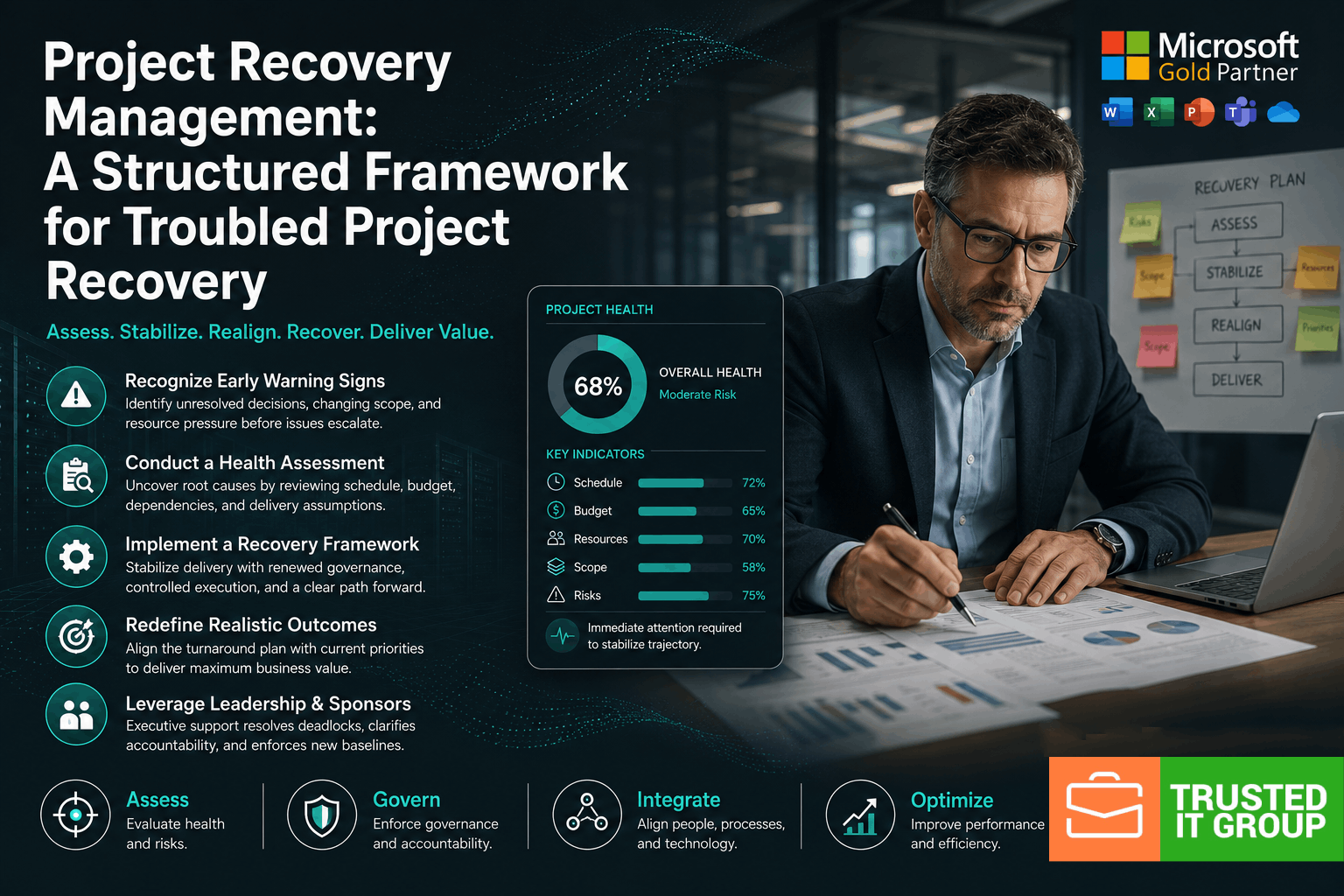
Not every delayed initiative requires a full project turnaround plan, as ordinary variance is a natural part of complex enterprise delivery. Learn this project recovery management framework to conduct a health assessment and execute a successful turnaround.
Quick Summary
● Recognize early warning signs. Before a project reaches a crisis point, subtle delivery signals often indicate that standard mitigation is failing. Identifying unresolved decisions, changing scope, and resource pressure early allows leaders to intervene proactively.
● Conduct a project health assessment. Establishing the true delivery position requires an objective review of the current schedule, budget, and dependencies. This assessment uncovers the root causes of variance and validates the assumptions behind the existing plan.
● Implement a project recovery framework. Moving from diagnosis to stabilization requires a structured management capability rather than an improvised response. A formal framework ensures renewed governance, controlled execution, and a clear path forward.
● Redefine realistic project outcomes. Recovery is not about blindly preserving every aspect of the original business case. It involves determining what still needs to be achieved and aligning the project turnaround plan with current organizational priorities.
● Leverage PMO leadership and executive sponsors. Strong leadership is essential for resolving deadlocked decisions and clarifying accountability across the enterprise. Executive sponsors provide the authority needed to enforce new baselines and support the recovery team.
Introduction
Not every delayed initiative requires a full project turnaround plan, as ordinary variance is a natural part of complex enterprise delivery. However, when unresolved decisions, changing scope, and deteriorating dependencies begin to compound, organizations must recognize that standard mitigation may no longer be sufficient. Distinguishing between routine friction and systemic misalignment is the critical first step in preventing a challenged initiative from reaching an unmanageable crisis point.
A structured project health assessment establishes the true delivery position by objectively reviewing scope, schedule, resources, governance, and stakeholder alignment. Rather than improvising a response after a failure has occurred, enterprise leaders must treat project recovery management as a formal, repeatable capability. This structured approach moves methodically through diagnosis, stabilization, and replanning, ensuring that interventions are based on verified facts rather than outdated assumptions.
Trusted IT Group brings the project-management expertise, governance structure, and practical implementation support required to navigate these highly complex delivery environments. By applying a proven project recovery framework, organizations can clarify accountability, revisit strategic priorities, and establish realistic recovery milestones. Ultimately, this disciplined intervention helps teams focus on delivering tangible business value instead of rigidly attempting to preserve an obsolete original plan.
|
Primary
|
Secondary
|
|
project recovery plan
|
project turnaround strategy/recovery action plan/project rescue plan
|
|
project recovery management
|
recovery project management / PMO recovery capability/enterprise project recovery
|
|
project turnaround plan
|
turnaround management strategy/project realignment plan/delivery turnaround
|
|
project health assessment
|
project health check/delivery health review/project status assessment
|
|
troubled project recovery
|
failing project intervention / challenged project rescue / troubled project turnaround
|
|
project recovery framework
|
recovery methodology / structured recovery process/project stabilization framework
|
Key Factors Overview
|
Factor
|
Description
|
|
Scope and Assumptions
|
Evaluating whether the original project boundaries remain valid or require immediate realignment to reflect current business realities.
|
|
Resource Pressure
|
Assessing team capacity, workload distribution, and the availability of critical subject matter experts required for delivery.
|
|
Governance and Decisions
|
Reviewing the effectiveness of steering committees, escalation paths, and the overall speed of executive decision-making.
|
|
Dependencies and Risks
|
Identifying deteriorating cross-project links and unmitigated threats that directly impact the critical path of the initiative.
|
|
Stakeholder Alignment
|
Ensuring that project sponsors, business owners, and technical teams share a unified understanding of current priorities.
|
|
Plan vs. Actual Progress
|
Analyzing persistent differences between reported status and tangible deliverables to establish an accurate performance baseline.
|
Before Checklist
● Acknowledge the delivery reality. Leadership must accept that the current project trajectory is no longer viable and requires formal intervention. This acceptance prevents teams from wasting time on ineffective, routine mitigation strategies.
● Pause non-critical execution. Halting non-essential work prevents further scope creep and stops the accumulation of technical or operational debt. This temporary pause provides the breathing room necessary to conduct a thorough evaluation.
● Engage the executive sponsor. Securing immediate support from top-level leadership is vital for clearing political roadblocks and reallocating resources. The sponsor must be prepared to make difficult decisions regarding scope and budget.
● Initiate a project health assessment. Deploy an objective team to review the project artifacts, interview stakeholders, and identify root causes. This assessment forms the factual foundation for the upcoming recovery strategy.
After Checklist
● Establish renewed governance. Implement strict oversight mechanisms, including revised steering committee structures and tighter change-control processes. Clear governance ensures that the project does not slip back into old, unproductive habits.
● Baseline the new project recovery plan. Formally approve the revised schedule, budget, and scope with all key stakeholders. This new baseline serves as the official measurement for all future progress and performance.
● Monitor controlled execution. Track the project closely against the new recovery milestones, ensuring that early deliverables are met on time. Continuous monitoring allows the PMO to address any new friction before it escalates.
● Capture and integrate lessons learned. Document the root causes of the initial variance and the strategies that successfully stabilized the project. Integrating these insights into enterprise methodologies strengthens overall project recovery management capabilities.
Table of Contents
SECTION 1: Structuring the Intake Workflow
1. What signals indicate the need for a project health assessment?
2. When does ordinary project variance become a troubled project recovery scenario?
3. Why is executive sponsor involvement critical to a project turnaround plan?
SECTION 2: Executing the Recovery Framework
4. How does a project recovery framework stabilize delivery?
5. Can a project recovery plan redefine original project outcomes?
6. How do PMO leaders integrate recovery lessons into wider project recovery management?
SECTION: STRUCTURING THE INTAKE WORKFLOW
FAQ 1: What signals indicate the need for a project health assessment?
Early warning signs include unresolved decisions, persistent resource pressure, missed milestones, and a growing disconnect between the reported status and actual progress.
A comprehensive [Project Health Assessment](https://www.oreilly.com/library/view/project-health-assessment/9781482252828/) evaluates the underlying health of an initiative by reviewing scope, schedule, dependencies, and the assumptions behind the existing plan. When project teams experience unclear ownership or deteriorating cross-functional dependencies, an independent review helps establish the true delivery position. Trusted IT Group utilizes these assessments to provide PMO directors and IT leaders with an objective baseline before issues escalate into severe delivery failures.
Real Results: An enterprise PMO identified a pattern of delayed vendor deliverables and used a health assessment to uncover misaligned technical assumptions, allowing them to realign the schedule before the next major funding gate.
Takeaway: Proactive health assessments transform vague delivery concerns into actionable, data-driven insights.
FAQ 2: When does ordinary project variance become a troubled project recovery scenario?
Variance becomes a troubled project recovery scenario when standard mitigation strategies fail to correct the trajectory and the project begins moving fundamentally away from its intended business outcomes.
All complex initiatives experience minor schedule slips or budget fluctuations, which project managers typically handle through routine risk management and contingency planning. However, [Troubled Project Recovery](https://www.projectmanagement.com/project-plans/223942/Troubled-Project-Recovery) is required when systemic issues, such as a breakdown in governance, continuous scope creep, or a loss of stakeholder confidence, prevent the team from executing the plan. Recognizing this threshold early allows organizations to deploy a structured intervention rather than relying on improvised, reactive measures that often exacerbate the problem.
Real Results: A transformation program experiencing a ten percent budget variance was managed normally, but when core architectural decisions remained unresolved for three months, leadership formally initiated a recovery protocol. .
Takeaway: Structured recovery is necessary when project control mechanisms are no longer effective at correcting delivery deviations.
FAQ 3: Why is executive sponsor involvement critical to a project turnaround plan?
Executive sponsors provide the necessary authority to resolve deadlocked decisions, clarify accountability, and approve the revised priorities essential for a successful turnaround.
A [Project Turnaround](https://resultant.com/digital-transformation/project-turnaround/) cannot succeed if the project team is left to navigate organizational politics and resource constraints without top-down support. Sponsors must actively participate in the recovery process to clear roadblocks, renegotiate business expectations, and ensure that the broader organization supports the new direction. Trusted IT Group partners with executive sponsors to establish renewed governance structures, ensuring that leadership remains engaged throughout the stabilization and replanning phases.
Real Results: By actively participating in weekly recovery steering committees, a CIO sponsor successfully reallocated critical engineering resources from lower-priority tasks to stabilize a delayed ERP deployment.
Takeaway: Active executive sponsorship is the catalyst that transforms a theoretical recovery plan into an executable reality.
SECTION: EXECUTING THE RECOVERY FRAMEWORK
FAQ 4: How does a project recovery framework stabilize delivery?
A project recovery framework stabilizes delivery by temporarily halting non-essential work, diagnosing root causes, and establishing immediate control over scope and resources.
The stabilization phase of a recovery effort focuses on stopping the bleeding before attempting to build a new long-term schedule. According to research on [Project Failures and How to Get Rid of them](https://journalmodernpm.com/manuscript/index.php/jmpm/article/view/JMPM02611), this involves triaging current activities, securing critical project assets, and implementing strict change-control mechanisms to prevent further scope creep. By moving methodically through diagnosis and stabilization, organizations create a secure foundation for replanning and controlled execution, ensuring that the same mistakes are not repeated.
Real Results: A financial services PMO paused all new feature development on a struggling application, using a two-week stabilization period to resolve critical defects and re-establish a reliable code baseline.
Takeaway: Stabilization prioritizes immediate control and triage over rapid, uncoordinated forward movement.
FAQ 5: Can a project recovery plan redefine original project outcomes?
Yes, a highly effective project recovery plan often redefines original outcomes to focus on what still needs to be achieved rather than rigidly preserving an outdated business case.
As business environments evolve, the assumptions that underpinned the initial project charter may no longer be valid, making the original goals impossible or irrelevant. [Project Recovery 101: Turning Around Failing Projects](https://www.paymoapp.com/blog/project-recovery-101/) emphasizes that recovery efforts must evaluate whether the business benefit can still be delivered within a reasonable structure. Trusted IT Group helps organizations facilitate these difficult conversations, guiding stakeholders to agree on a revised, realistic scope that delivers maximum value under the current constraints.
Real Results: A delayed infrastructure upgrade was successfully recovered by descoping secondary regional offices, allowing the team to deliver the core network modernization for the global headquarters on time.
Takeaway: Successful recovery requires the flexibility to adapt project objectives to current realities rather than past promises.
FAQ 6: How do PMO leaders integrate recovery lessons into wider project recovery management?
PMO leaders integrate lessons by updating organizational methodologies, refining risk thresholds, and training project managers to recognize early warning signs.
A recovery effort should not be viewed as an isolated event, but rather as a vital source of intelligence for improving enterprise practices. By conducting thorough post-recovery evaluations, PMO directors can identify systemic weaknesses in their governance, resource allocation, or estimation practices, as outlined in [Five Critical First Steps in Recovering Troubled Projects](https://www.pmi.org/learning/library/critical-steps-recovering-troubled-projects-7352). Embedding these insights into standard operating procedures ensures that the organization builds a more resilient delivery culture, reducing the likelihood of future projects requiring drastic intervention.
Real Results: After recovering a major compliance program, a PMO director updated the enterprise risk framework to mandate independent health checks for all tier-one projects exceeding a five percent schedule variance.
Takeaway: Institutionalizing lessons learned transforms a single project crisis into a catalyst for long-term organizational maturity.