Quick Summary
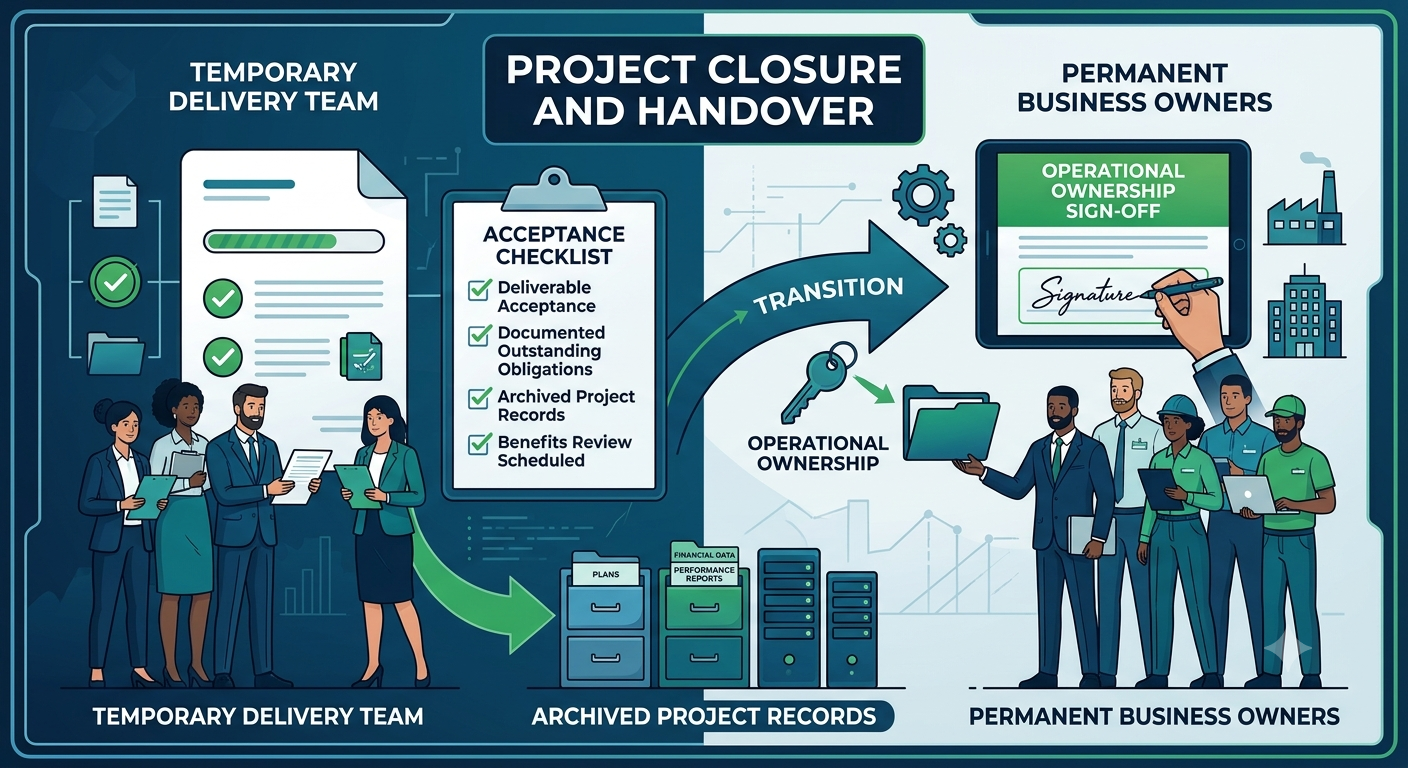
● Define clear acceptance criteria. A structured project handover process requires objective standards to confirm that the delivered work meets the agreed-upon requirements. This prevents scope creep and ensures business owners know exactly what they are receiving.
● Document outstanding obligations. It is common for minor tasks to remain incomplete at the time of formal sign-off. Documenting these unresolved items with assigned owners and deadlines ensures they are not forgotten after the project team disbands.
● Establish operational ownership. Project outputs need accountable owners after the delivery team withdraws, as noted in [Project Closure Needs an Operational Owner | Crowe AHFAD](https://www.crowe.com/ye/insights/advisory-insights/project-and-change-management-insights/project-handover). A formal transfer ensures the receiving team has the authority, capacity, and resources to sustain the work.
● Retain essential project records. Archiving plans, baselines, and final performance data puts critical information somewhere retrievable for future audits or operational troubleshooting. This protects the organization from losing valuable institutional knowledge.
● Separate delivery from benefits. Deliverable acceptance confirms the project scope was met, but it does not measure long-term business value. Assigning responsibility for reviewing business outcomes at a later date ensures the organization tracks the actual return on investment.
Introduction
A structured project closure and handover process is the critical bridge between temporary project delivery and ongoing business operations. Without a formal transition, organizations risk leaving completed work without an accountable owner, leading to operational confusion and degraded value. PMO leaders and project managers must guide business owners through a deliberate acceptance process to ensure a clean transfer of responsibility.
Acceptance establishes whether agreed requirements have been met, while operational transfer assigns responsibility for using and maintaining the output. As highlighted in [Project Closure Needs an Operational Owner | Crowe AHFAD](https://www.crowe.com/ye/insights/advisory-insights/project-and-change-management-insights/project-handover), a deliverable may be accepted while support arrangements are still being finalized. Distinguishing between these decisions allows the project team to close out their administrative duties while the business prepares for long-term ownership.
Ultimately, closing a project is about transferring the means to operate. By confirming acceptance against agreed criteria, documenting unresolved items, and archiving essential records, organizations create a stable environment for the receiving team. If your organization struggles with chaotic transitions, our PMO advisory services can help you design a handover framework that protects your project investments.
|
Primary
|
Secondary
|
|
project closure and
handover
|
project closure phase / formal project closure/project handover process
|
|
project closure checklist
|
project closeout checklist/closure activities/handover documentation
|
|
project acceptance criteria
|
deliverable acceptance / formal sign-off / acceptance record
|
|
project handover process
|
transition to operations/handover package / operational transfer
|
|
operational ownership after project completion
|
receiving owner / operational responsibility/business outcomes
|
Key Factors Overview
|
Factor
|
Description
|
|
Deliverable Acceptance
|
The formal process of comparing completed work against agreed project acceptance criteria to confirm requirements have been met.
|
|
Operational Transfer
|
The reassignment of responsibility from the temporary project team to the permanent business owners who will manage the output.
|
|
Outstanding Obligations
|
Minor unresolved items or defects documented at sign-off that require a clear resolution plan and assigned accountability.
|
|
Records Retention
|
The archiving of project plans, financial data, and technical documentation to support future operational needs and audits.
|
|
Benefits Realization
|
The post-closure assessment of whether the accepted deliverables actually produced the intended strategic or financial value.
|
Before Checklist
● Confirm project acceptance criteria. Review the initial scope and ensure all stakeholders agree on the objective measures used to evaluate the final deliverables. This prevents subjective disagreements during the final review.
● Compile the handover documentation. Gather all necessary operating procedures, administrative credentials, and support contacts required for daily management. The receiving team must have the working information needed to operate unaided.
● Identify the receiving owner. Clarify exactly who will assume operational ownership after project completion. This individual or team must have the capacity and authority to manage the new asset.
● Draft the open-items list. Document any known defects, deferred tasks, or minor unresolved issues that will persist past the handover date. Assign a specific owner and a target resolution date for each item.
After Checklist
● Execute formal sign-off. Obtain written approval from the sponsor and the receiving business owner acknowledging that the deliverables are accepted. This formal act releases the project team from daily delivery responsibilities.
● Archive project records. Store all final performance reports, change logs, and acceptance certificates in a centralized, secure repository. This ensures the organization retains a permanent record of the project's history.
● Transfer operational control. Formally hand over all administrative access, licenses, and support responsibilities to the permanent business owner. The project team must cease acting as the primary support mechanism.
● Schedule the benefits review. Assign a specific business leader to evaluate the project's strategic outcomes at a defined future date. This ensures the organization measures actual value realization long after the project closes.
Table of Contents
SECTION 1: Acceptance and Ownership
1. What defines project acceptance criteria during the handover process?
2. How do you handle unresolved items at project sign-off?
3. Why is operational ownership after project completion critical?
SECTION 2: Benefits and Records
4. When should you assess if intended business benefits have been achieved?
5. Can a project closure checklist prevent operational failures?
6. How do you retain essential project records after the team steps away?
SECTION: STRUCTURING THE INTAKE WORKFLOW
FAQ 1: What defines project acceptance criteria during the handover process?
Project acceptance criteria are the objective, agreed-upon standards that deliverables must meet to be considered complete.
These criteria are typically established early in the project lifecycle and documented in the charter or scope statement. During the project handover process, the project manager compares the final output against these specific metrics using evidence like test results or inspection reports. As noted in [PMP Project Closure Checklist: Steps, Lessons & Handover](https://www.techademy.com/pmp-project-closure-checklist), without explicit, documented acceptance, the project cannot formally close.
Real Results: A financial services firm avoided a costly scope dispute by requiring the business owner to sign an acceptance record that explicitly mapped the final reporting dashboard to the original criteria.
Takeaway: Always evaluate final deliverables against objective, pre-defined standards rather than subjective opinions.
FAQ 2: How do you handle unresolved items at project sign-off?
Unresolved items should be documented in a formal open-items list with assigned owners and strict deadlines.
It is rare for a complex project to finish without a few minor defects or deferred tasks. Instead of delaying the entire project closure and handover, teams can utilize provisional acceptance. This involves accepting the core deliverables while formally documenting the outstanding obligations, ensuring accountability remains clear even after the primary project team disbands.
Real Results: A logistics company successfully closed a facility upgrade project on time by moving three minor electrical tasks to an open-items list managed by the ongoing maintenance team.
Takeaway: Documenting outstanding work allows the project to close without letting minor issues fall through the cracks.
FAQ 3: Why is operational ownership after project completion critical?
Operational ownership ensures that a specific, capable entity is responsible for sustaining and supporting the project's output.
When a project ends, the temporary delivery team is reassigned, leaving a support vacuum if a permanent owner is not established. A structured handover establishes who will operate, maintain, and support the change, preventing the project team from being dragged back into routine maintenance. The receiving owner must have the authority, funding, and resources to manage the asset effectively.
Real Results: A retail chain prevented a new inventory process from collapsing by formally transferring operational ownership to the regional supply chain director before releasing the project manager.
Takeaway: Never release project resources until a permanent business owner has accepted responsibility for ongoing operations.
SECTION: BENEFITS AND RECORDS
FAQ 4: When should you assess if intended business benefits have been achieved?
Business benefits should be assessed during a scheduled review period months after the project has been formally closed.
Deliverable acceptance only confirms that the project team built what was requested; it does not prove that the output generated value. The responsibility for tracking these outcomes shifts to the business owner after closure. As detailed in [Project closure · Product Digest](https://www.productdigest.io/concepts/project-closure), the project manager should record the benefit claimed, the baseline measure, and who owns the benefit before handing it over.
Real Results: A healthcare provider scheduled a benefits realization review six months post-closure, allowing them to accurately measure a 15 percent reduction in patient wait times.
Takeaway: Separate the immediate acceptance of deliverables from the long-term measurement of strategic business value.
FAQ 5: Can a project closure checklist prevent operational failures?
A comprehensive project closure checklist prevents failures by ensuring no critical handover steps or support arrangements are missed.
A weak closeout leaves the operating team without necessary administrative accounts, renewal dates, or escalation paths. By following a structured checklist, project managers can systematically verify that all training is complete, warranties are transferred, and support contacts are established. This methodical approach, supported by resources like the [Project closeout checklist for project managers | Free Template](https://www.trychaser.com/checklist-articles/project-closeout-checklist-for-project-managers), protects the receiving organization from operational risks.
Real Results: An engineering firm avoided a critical system outage by using a closure checklist that prompted the transfer of vendor support contracts to the permanent IT operations desk.
Takeaway: Use a standardized checklist to guarantee that the receiving team has all the tools and information required to succeed.
FAQ 6: How do you retain essential project records after the team steps away?
Essential records must be archived in a centralized, searchable repository that the permanent organization can access.
Archiving puts the plans, baselines, change decisions, and final performance data somewhere retrievable for future use. This documentation is vital for resolving future disputes, handling warranty claims, or informing subsequent projects. The project manager is responsible for organizing and transferring these files before their final departure from the initiative.
Real Results: A manufacturing company successfully defended against a vendor payment dispute two years after project closure because the project manager had properly archived the signed acceptance certificates.
Takeaway: Securely archiving project documentation protects the organization's legal and financial interests long after the project ends.