Quick Summary
● Acknowledge capacity limits: Organizations cannot treat every approved initiative as a top priority without fracturing their delivery capabilities. When everything is urgent, teams lose the ability to focus on the work that truly drives strategic outcomes.
● Move beyond simple labels: Tagging a project as critical or strategic does not help leaders make difficult trade-offs. True portfolio decision making requires understanding how initiatives rank relative to one another.
● Evaluate the portfolio holistically: Approving projects in isolation ignores the cumulative burden on shared resources and leadership attention. A robust project prioritization framework evaluates new requests against existing commitments.
● Embrace dynamic reprioritization: Business conditions, costs, and strategic goals change constantly throughout the fiscal year. Organizations must continuously reassess their active projects to ensure they still warrant their current funding and focus.
● Leverage the PMO for visibility: A mature PMO does not dictate business priorities but instead illuminates the consequences of executive choices. By making trade-offs visible, the PMO enables leadership to govern the portfolio effectively.
Introduction
Several initiatives are approved, each with a dedicated sponsor, a valid business case, and a clear connection to something important. Marketing considers its platform migration critical, while operations views process automation as equally urgent. IT has infrastructure work that cannot be delayed, and leadership has just introduced another strategic initiative.
On paper, they can all be classified as high priority. The problem begins when the organization does not have enough capacity to treat them all that way. When demand exceeds execution capability, the portfolio becomes a bottleneck rather than an engine for value delivery.
Prioritization only becomes meaningful when it influences what receives resources, what moves first, what waits, and sometimes what stops. Without this discipline, organizations risk spreading their talent and capital too thin across competing agendas.
Why Portfolios Become Overloaded Despite Prioritization Processes
Portfolios frequently become overloaded because priorities are assigned project by project rather than portfolio-wide. When a business unit proposes an initiative, they naturally view it as their most critical endeavor. Without a centralized view, organizations approve work without considering the cumulative impact on existing commitments.
Executive sponsorship often creates immense pressure to classify more initiatives as urgent. When a senior leader champions a project, objective project selection criteria are sometimes bypassed to accommodate their request. This dynamic bypasses formal project portfolio governance and dilutes the focus of teams already working at capacity.
Strategic alignment is also frequently interpreted too broadly. Almost any project can be loosely tied to a corporate objective if the business case is written creatively enough. Furthermore, there is often a deep reluctance to defer or stop initiatives that already have momentum, leading to a bloated portfolio where nothing is ever formally deprioritized.
High Priority Is Not a Meaningful Portfolio Strategy
Broad labels break down entirely when too many projects receive them. If fifty initiatives are labeled as critical, strategic, urgent, or high priority, the labels lose all practical utility. They fail to create a relative ordering or force the explicit trade-offs required for effective portfolio decision-making.
As noted in [Project portfolio management and managing multiple projects - PMI](https://www.pmi.org/learning/library/portfolio-management-multiple-projects-497), there is a tendency to assign all projects in the corporate portfolio a top priority. This places all projects in an equally competitive position for limited resources. Consequently, teams are left to guess which work actually matters most to the organization.
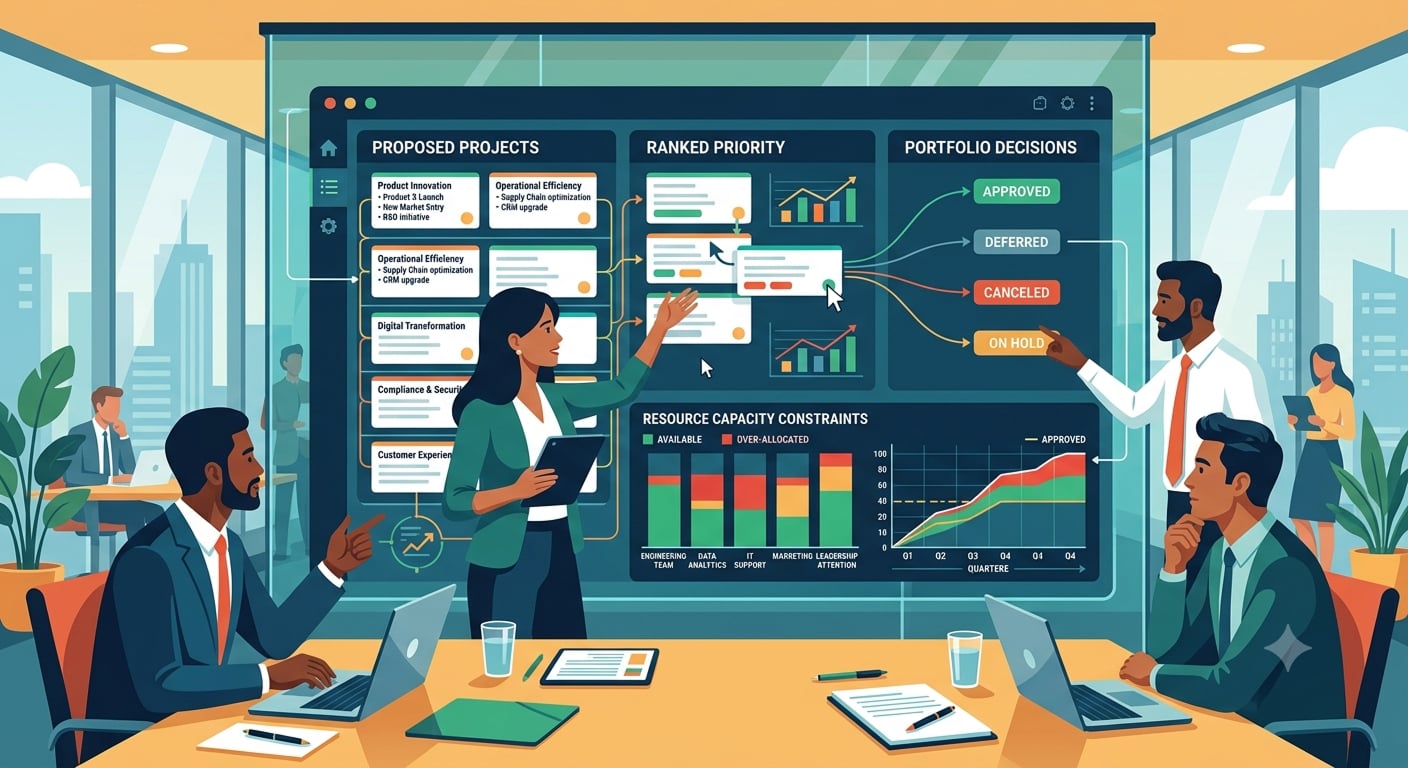
Prioritization must help leaders make actual choices rather than just categorizing work. A project prioritization framework does not need to be a perfect numerical scoring model, but it must force a ranking. If two "critical" projects require the same specialized engineering team, leadership must decide which one moves first.
What Meaningful Portfolio Prioritization Should Help Leadership Decide
Meaningful portfolio prioritization is about facilitating difficult decisions rather than adhering to a rigid framework. Leaders must determine which organizational outcomes matter most during the current planning period. They must then identify which initiatives contribute most directly to those specific outcomes.
It is also necessary to identify which projects are mandatory due to regulatory, contractual, operational, or security requirements. These initiatives often consume a fixed portion of organizational capacity before discretionary strategic work can even begin. Understanding where specialist or leadership capacity is already constrained is vital for realistic planning.
When a new initiative enters the portfolio, leaders must ask what existing commitments change to accommodate it. They must also regularly question which active projects still justify their place in the portfolio based on current information. These questions transform project portfolio prioritization from a theoretical exercise into a practical management tool.
The Missing Question When New Work Enters the Portfolio
The most critical question in portfolio management is often the one least asked. If we say yes to this new initiative, what are we saying no to, delaying, or reducing elsewhere? Organizations frequently treat portfolio capacity as expandable when it is actually strictly constrained.
A new initiative inevitably affects resource availability, funding, and executive attention. It can disrupt technology teams, delay dependent projects, and extend delivery timelines across the board. Ignoring these impacts does not make them disappear; it simply pushes the friction down to the delivery teams.
As highlighted in [Strategic Portfolio Management: Concepts, Lifecycle, and the Role of TBM](https://www.tbmcouncil.org/strategic-portfolio-management-concepts-lifecycle-and-the-role-of-tbm/), investments consume finite organizational resources, and the number of potential investments often exceeds the resources available. Acknowledging this reality is the first step toward mature PMO prioritization.
Why Prioritization Needs to Continue After Projects Are Approved
Priorities can and should change because the environment in which the organization operates is not static. Corporate strategy changes, initial assumptions prove incorrect, costs increase, and projected benefits decline. Market or regulatory conditions shift, rendering previously critical projects obsolete.
Sometimes, another initiative simply becomes more important due to an unexpected competitive threat or a new business opportunity. If prioritization is treated as a one-time annual exercise, the portfolio will quickly fall out of alignment with reality. Active projects must be continuously evaluated against new demands.
Portfolio prioritization should therefore be a dynamic, ongoing discipline. Organizations must build the capability to pause or stop in-flight work when it no longer represents the best use of organizational capacity. This requires courage, but it is essential for maintaining a healthy portfolio.
What a Mature PMO Contributes
A mature PMO facilitates visibility and better decision-making rather than dictating what the business should prioritize. The PMO maintains a portfolio-wide view, ensuring that all active and proposed work is visible to senior leadership. This comprehensive perspective is necessary for identifying bottlenecks and overlapping efforts.
The PMO is responsible for making trade-offs visible and connecting initiatives to strategic outcomes. When leadership wants to add a new project, the PMO shows them the impact of adding or delaying work across the rest of the portfolio. They support consistent decision criteria and help leadership reassess existing commitments objectively.
According to [Project Prioritization Frameworks: Control Capital & Execution | Handle](https://handle.ae/business-strategy/pmo-and-execution-governance/project-prioritization-framework), prioritization frameworks ensure that execution capacity and leadership attention concentrate on initiatives that advance enterprise strategy. The PMO provides the structure and data required to make this strategic project prioritization a reality.
|
Primary
|
Secondary
|
|
project portfolio prioritization
|
portfolio decision making/project selection criteria / PMO prioritization
|
|
portfolio decision making
|
project portfolio governance / strategic project prioritization/portfolio prioritization
|
|
project selection criteria
|
project prioritization framework / PMO prioritization/project portfolio prioritization
|
|
PMO prioritization
|
strategic project prioritization/portfolio decision making/project portfolio governance
|
|
project portfolio governance
|
project prioritization framework/portfolio prioritization/project selection criteria
|
Key Factors Overview
|
Factor
|
Description
|
|
Capacity Constraints
|
The finite limit of organizational resources, funding, and leadership attention available for project execution.
|
|
Strategic Alignment
|
The degree to which a proposed initiative directly supports the current organizational goals and objectives.
|
|
Relative Ranking
|
The practice of comparing projects against one another rather than evaluating them in isolated silos.
|
|
Dynamic Reprioritization
|
The ongoing process of reassessing active projects to ensure they still warrant continued investment.
|
|
Trade-off Visibility
|
The clear understanding of what must be delayed or stopped when a new initiative is introduced.
|
Before Checklist
● Audit current project labels: Review all active initiatives to see how many are currently classified as critical or high priority. If more than a quarter of the portfolio holds this status, your labeling system is likely masking capacity issues.
● Identify resource bottlenecks: Map out which specialized teams or leaders are consistently over-allocated across multiple projects. This will highlight where your portfolio is structurally constrained regardless of project priority.
● Review recent approval decisions: Examine the last five projects approved to determine if any existing work was paused to accommodate them. If nothing was delayed, you may be artificially inflating your delivery capacity assumptions.
● Assess strategic alignment: Ask project sponsors to explicitly link their in-flight projects to the current fiscal year objectives. Initiatives that rely on outdated strategic goals should be flagged for immediate review.
After Checklist
● Implement forced ranking: Require leadership to rank the top ten strategic initiatives in absolute numerical order. This eliminates the ambiguity of having multiple projects sharing the exact same priority level.
● Establish trade-off discussions: Mandate that every new project proposal includes a recommendation on what existing work should be deferred. This forces sponsors to acknowledge the reality of finite organizational capacity.
● Schedule quarterly portfolio reviews: Move away from annual planning by instituting regular sessions to reassess all active investments. Use these meetings to formally stop or pause projects that are underperforming or no longer relevant.
● Standardize project selection criteria: Develop a consistent set of evaluation metrics that apply to all business units. This ensures that marketing, IT, and operations projects are judged against the same standard of value.
Table of Contents
SECTION 1: UNDERSTANDING PORTFOLIO PRIORITIZATION
1. What is the primary goal of project portfolio prioritization?
2. Why do traditional project selection criteria often fail in practice?
3. How does project portfolio governance support better decision-making?
SECTION 2: IMPLEMENTING EFFECTIVE FRAMEWORKS
4. When should an organization adjust its project prioritization framework?
5. Can a PMO enforce strategic project prioritization independently?
6. How do you handle executive sponsors who demand top priority for their projects?
SECTION: UNDERSTANDING PORTFOLIO PRIORITIZATION
FAQ 1: What is the primary goal of project portfolio prioritization?
The primary goal is to ensure that finite organizational resources are directed toward the initiatives that deliver the highest strategic value. It is about making deliberate choices regarding what work gets funded, staffed, and executed.
Without this discipline, organizations spread their capacity too thin across too many projects. This results in delayed timelines, burned-out teams, and a failure to realize the intended business benefits. Prioritization creates the focus necessary for successful execution.
Real Results: A financial services firm reduced its active project count by 30 percent, resulting in a 40 percent increase in on-time project delivery.
Takeaway: Prioritization is a tool for maximizing value delivery, not just a method for organizing a list of tasks.
FAQ 2: Why do traditional project selection criteria often fail in practice?
Traditional criteria fail when they are applied in isolation without considering the broader portfolio context or existing capacity constraints. A project might score highly on a standalone business case but still be the wrong choice if it competes for already exhausted resources.
Furthermore, criteria are often manipulated by sponsors to ensure their projects meet the threshold for approval. If the criteria do not force a relative comparison between competing initiatives, they become a rubber stamp rather than a filtering mechanism.
Real Results: A healthcare provider abandoned its static scoring model in favor of forced ranking, eliminating the issue of having fifty "critical" projects.
Takeaway: Selection criteria must facilitate relative comparison and account for actual delivery capacity to be effective.
FAQ 3: How does project portfolio governance support better decision-making?
Governance provides the structured forums, standardized data, and clear authority required to make objective portfolio decisions. It establishes the rules of engagement for how projects are proposed, evaluated, and monitored.
Effective governance ensures that decisions are made transparently and are aligned with corporate strategy. It prevents individual departments from launching shadow initiatives that drain resources away from agreed-upon enterprise priorities.
Real Results: A manufacturing company implemented a monthly governance board, reducing unauthorized departmental projects by 80 percent.
Takeaway: Strong governance transforms prioritization from a theoretical concept into an enforceable business practice.
SECTION: IMPLEMENTING EFFECTIVE FRAMEWORKS
FAQ 4: When should an organization adjust its project prioritization framework?
An organization should adjust its framework whenever there is a significant shift in corporate strategy, market conditions, or financial constraints. The framework must reflect the current reality of what the business is trying to achieve.
If the framework consistently approves projects that leadership later overrides, the criteria are misaligned with actual executive priorities. Regular calibration ensures the model remains a trusted tool for portfolio decision-making.
Real Results: A retail chain updated its prioritization framework to heavily weight digital transformation, successfully pivoting its portfolio during a market disruption.
Takeaway: A prioritization framework is a living mechanism that must evolve alongside the strategic goals of the organization.
FAQ 5: Can a PMO enforce strategic project prioritization independently?
No, a PMO cannot enforce prioritization independently; it requires the active participation and backing of senior executive leadership. The PMO facilitates the process, provides the data, and highlights the trade-offs, but leaders must make the final calls.
If the PMO attempts to dictate priorities without executive support, it will be viewed as an administrative roadblock. The PMO's true power lies in its ability to make the consequences of poor prioritization visible to those who hold the authority.
Real Results: A technology company's PMO shifted from acting as a gatekeeper to a strategic advisor, resulting in full C-suite adoption of their portfolio recommendations.
Takeaway: The PMO illuminates the path, but executive leadership must be willing to walk it by making the hard choices.
FAQ 6: How do you handle executive sponsors who demand top priority for their projects?
You handle them by making the cost of their demand completely transparent to the rest of the executive team. When a sponsor insists their project is critical, the PMO must show exactly which other strategic initiatives will be delayed to accommodate it.
This shifts the conversation from a debate about the project's importance to a discussion about organizational trade-offs. It forces the executive team to collectively agree on whether the new request truly supersedes existing commitments.
Real Results: A logistics firm required sponsors to present their urgent requests to a peer committee, drastically reducing the number of projects bypassing standard intake.
Takeaway: Transparency regarding trade-offs is the most effective defense against the loudest voice in the room.
Conclusion
A portfolio does not become prioritized simply because projects have urgent labels attached to them. It becomes prioritized when leadership can make informed choices about what receives finite organizational capacity. True prioritization requires discipline, transparency, and a willingness to make difficult trade-offs.
When organizations stop calling everything a high priority, they regain control over their delivery capabilities. They can focus their talent and capital on the initiatives that truly matter. Ultimately, effective portfolio prioritization is the mechanism that translates strategic intent into measurable business value.
.jpg)